
Geoff Butcher wrote:Since these are dual circuit brakes, surely if a rear nipple, say, is open, the secondary circuit should still be doing its stuff, if not there isn't much point in having two circuits.
There is quite a distance between the primary piston and secondary. Only when the primary has covered the distance it will start pushing the secondary piston. Because the throw of an unmodified brake pedal in a Midas is about 30% less than in a Metro (thanks to the shallow floor) it needs to be 100% efficient. I did not modify my pedal because it catches almost immediately. I had similar problems as you and found out on my brake servo I could push the lower input rod while the outgoing did not move (the brake servo has 2 rods with the bladder in between). I replaced the brake servo with an adaptor plate and a direct linkage going into the primary brake piston. I adjusted it so that the piston just sits below the vent hole. The vent hole is an open connection between the reservoir and the brake lines and is there for brake fluid expansion. The brakes only will work when the piston has passed this vent hole, so that's another small dead stroke. If the piston sits above this vent hole, the brakes will seize when the fluid gets warmed up, a well known culprit. If the primary piston sits too low the brake pedal has a huge dead stroke. To adjust it, I had removed the reservoir and stuck a needle in it so I could feel where the primary piston was and when it would pass the hole.
Note, the secondary piston hangs on a small pin which is pushed in before the reservoir is placed back, so is always at the right position (unless you forgot to install it
 ), see the cross section in the Haynes.
If you are completely desperate it would be a good troubleshooting step to pump the reservoir empty and remove it. Then put a needle in the vent hole and notice at what pedal position the primary piston pushes against it. Then you have found the dead stroke of the brake pedal. The smaller this dead stroke the better obviously. I have the feeling on your car the dead stroke will be huge.
To clarify things here are a few pics:
- master cylinder.jpg (38.65 KiB) Viewed 11834 times
the master cylinder with the primary piston and the upper piston (right one on the pic) being the secondary
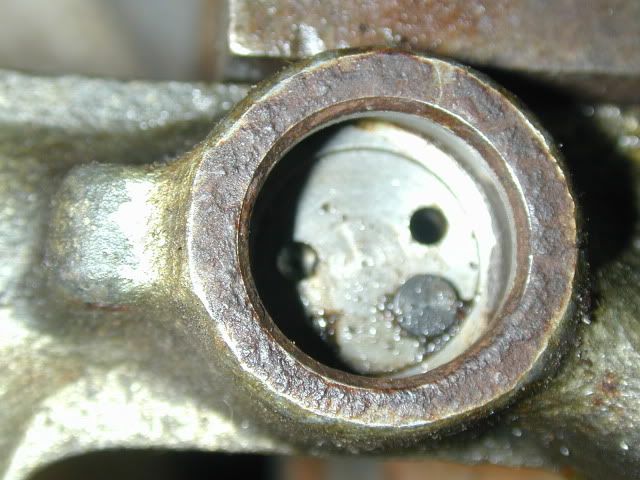
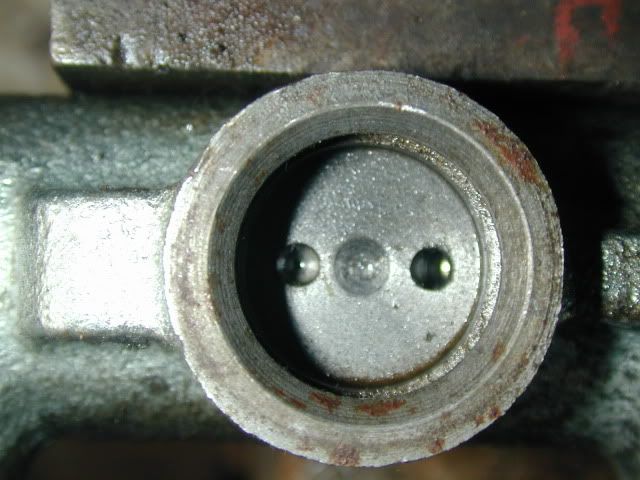
- vent hole.jpg (56.95 KiB) Viewed 11834 times
The right hole is the vent hole that is an open connection between the reservoir and the brake lines.
- brake1.jpg (30.82 KiB) Viewed 11834 times
My adaptor plate that replaces the brake servo
- brake2.jpg (30.68 KiB) Viewed 11834 times
The adjustable push pin that goes straight from the brake pedal into the primary piston