Rear shock absorbers
Moderator: The Midas Forum Staff
-
Geoff Butcher
- Posts: 752
- Joined: Fri Dec 05, 2008 9:10 pm
- Location: Braintree
Re: Rear shock absorbers
I don't understand this concept of 'preloading the spring'. Having the spring partly compressed on the damper before installing it is no different to using a spring compressor on a non-coilover setup.
Geoff

Re: Rear shock absorbers
So if you have 4" of travel say, your 75 lb springs will be bottomed out by a 600 lb load or 272 kgs, surely the rear of a 800 kg ish car weighs more than that?
Re: Rear shock absorbers
I think you've hit the nail on the head, what is weight on the rear of the car? 25% of the overall loading??? I don't know. How do we find out, a pair of bathroom scales!Stuart wrote:So if you have 4" of travel say, your 75 lb springs will be bottomed out by a 600 lb load or 272 kgs, surely the rear of a 800 kg ish car weighs more than that?
Alan
Re: Rear shock absorbers
Yes Bathroom scales is a favourite way for a lot of people, you may need two scales each side. I'd have thought rear weight distribution to be around 35% at a guess.

Re: Rear shock absorbers
I think Stuart may have a point there. My experience with swapping over springs mainly comes from racing, where we tended to go for stiffer springs. Stiffer springs tend to be shorter as they don't need the bump travel, hence the use of tie-wraps to keep them seated - we didn't go for such luxuries as helper springs but on a road car that strikes me as a good idea.Stuart wrote:So if you have 4" of travel say, your 75 lb springs will be bottomed out by a 600 lb load or 272 kgs, surely the rear of a 800 kg ish car weighs more than that?
However, if a stiffer spring is proportionately shorter than the standard one, it follows that a softer one needs to be longer to compensate for the additional travel taken up by the static load.
The figures suggested so far make sense to me:
A Gold convertible weighs around 720kg depending, so add a driver of around 80kg (approx 12.5 stone for us oldies) and you are up to your 800kg/1760lb figure.
65% front to 35% rear weight distribution also sounds right with the driver in place. So that is 140kg/308lb static load on both rear corner. Your bathroom scales will probably go that high, but I wouldn't suggest placing them under the front wheels!
If you only have 4" travel on your 75lb/in springs then they will bottom out under the static load.
Re: Rear shock absorbers
I hope everyone doesn't mind, I've merged an earlier discussion regarding spring rates onto the start of this thread.
Re: Rear shock absorbers
If you only have 4" travel on your 75lb/in springs then they will bottom out under the static load.
ACourtney
But that's not actually happens in practice. There is no sign of bottoming out, even with a passenger on board. Stan and I went to Donnington the other weekend. I guess Stan is about 11 stone and I am 14 stone,( that's about 350 pounds) with no sign of bottoming out. The suspension moves OK, but the initially hit is a bit harsh for my old bones. It has improved slightly since I wound off the damping. I used to be 21 stone, but the rear suspension never bottomed out!
I'm confused!!
Alan
ACourtney
But that's not actually happens in practice. There is no sign of bottoming out, even with a passenger on board. Stan and I went to Donnington the other weekend. I guess Stan is about 11 stone and I am 14 stone,( that's about 350 pounds) with no sign of bottoming out. The suspension moves OK, but the initially hit is a bit harsh for my old bones. It has improved slightly since I wound off the damping. I used to be 21 stone, but the rear suspension never bottomed out!
I'm confused!!
Alan
Re: Rear shock absorbers
Reading back through the thread, I think the confusion came from:
If your springs are 12" to start with then I would imagine that you have at least 8" of spring travel before the spring itself is bottoming out, or becoming coil-bound as it is known. Thus the actual travel limit is set by the damper, which is probably 6" in total.
If you have set the springs with the damper fully extended and 12" between the spring seats, then the helper spring will be virtually closed and the main spring will have a small preload. The static weight will then take up 4" of travel, leaving 2" more for absorbing bumps.
However, if you have fully compressed your 2" of 60lb/in helper spring, then that would be a pre-load of 120lb which means that main spring will also be compressed by 1.6 inches (1.6x75 = 120), thus the static load will compress it a further 3.4 inches, leaving you with 2.6 inches of travel.
Preloading the spring further will increase your ride height and give you more suspension travel, until you reach the point where the pre-load is higher than the static load. From that point on you have solid suspension until the dynamic load and static load combined exceed the pre-load. Could you have already exceeded that point? In which case that might account for the initial harshness that you mention.
Stuart wrote:So if you have 4" of travel say, your 75 lb springs will be bottomed out by a 600 lb load or 272 kgs, surely the rear of a 800 kg ish car weighs more than that?
If your springs are 12" to start with then I would imagine that you have at least 8" of spring travel before the spring itself is bottoming out, or becoming coil-bound as it is known. Thus the actual travel limit is set by the damper, which is probably 6" in total.
If you have set the springs with the damper fully extended and 12" between the spring seats, then the helper spring will be virtually closed and the main spring will have a small preload. The static weight will then take up 4" of travel, leaving 2" more for absorbing bumps.
However, if you have fully compressed your 2" of 60lb/in helper spring, then that would be a pre-load of 120lb which means that main spring will also be compressed by 1.6 inches (1.6x75 = 120), thus the static load will compress it a further 3.4 inches, leaving you with 2.6 inches of travel.
Preloading the spring further will increase your ride height and give you more suspension travel, until you reach the point where the pre-load is higher than the static load. From that point on you have solid suspension until the dynamic load and static load combined exceed the pre-load. Could you have already exceeded that point? In which case that might account for the initial harshness that you mention.
Re: Rear shock absorbers
To avoid confusion when I said springs bottomed out I actually meant suspension or damper. Helper run flats have no useful purpose with these lower spring rates.
It looks like the pre loading of these soft springs is the only way you're likely to get soft springs to actually work on your car as Alistair has pointed out.
If your 75 lb/inch springs are as short as these it does look like you won't be able to add the required pre load.
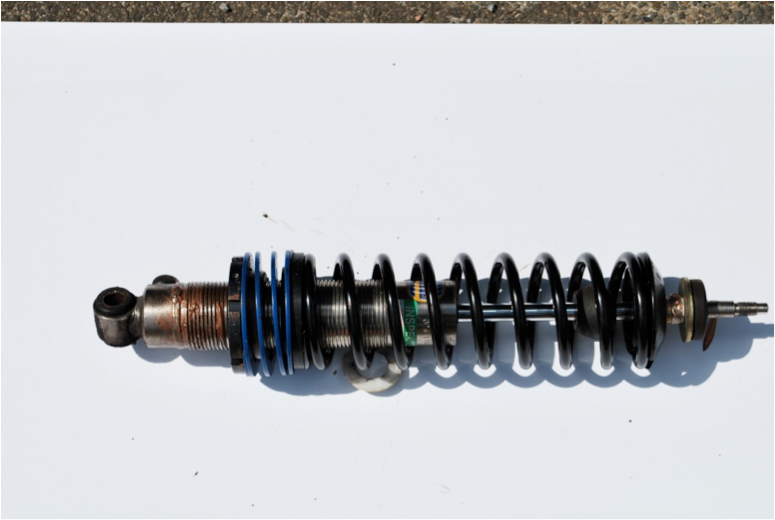
It looks like the pre loading of these soft springs is the only way you're likely to get soft springs to actually work on your car as Alistair has pointed out.
If your 75 lb/inch springs are as short as these it does look like you won't be able to add the required pre load.
-
Geoff Butcher
- Posts: 752
- Joined: Fri Dec 05, 2008 9:10 pm
- Location: Braintree
Re: Rear shock absorbers
If you have a 75lb/in spring in series with a 60lb/in, the rate of the combination will be about 33lb/in, until the short one goes coil bound, when it will of course jump to 75lb/in. 
Geoff